Tracking group size and shooting accuracy over time helps shooters understand real progress instead of guessing after each range session.
A good range day can feel great. A bad range day can feel frustrating. But one session by itself does not tell the whole story. If you are not recording your results, you are relying on memory, and memory is usually where shooting progress goes to die.
You might remember your best group. You might remember the one shot that landed exactly where you wanted. But will you remember the average group size, distance, ammo used, firearm setup, optic, shooting position, weather, and whether your accuracy improved compared to last month?
Probably not.
That is why tracking group size and shooting accuracy matters.
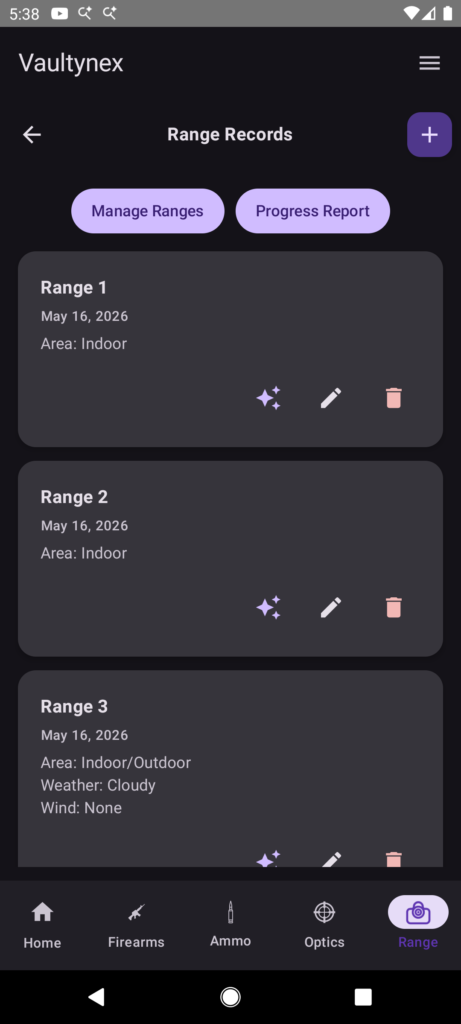
Vaultynex helps shooters keep range sessions, target photos, group sizes, firearms, ammo, optics, round counts, and notes connected in one place. That way, your range history becomes useful instead of being scattered across your phone gallery, paper targets, and random notes.
What Is Group Size?
Group size is the measurement of how close your shots land together on a target.
In simple terms, a smaller group usually means better consistency. If five shots land close together, that shows better repeatability than five shots spread across the target.
Group size is commonly measured from the two farthest bullet holes in a group. Many shooters measure from outside edge to outside edge, then subtract the bullet diameter to get a more accurate center-to-center measurement.
For casual tracking, you do not need to overcomplicate it. The main thing is consistency. Pick a method and use the same method every time.
A group size record can include:
• Number of shots in the group
• Group size measurement
• Distance to target
• Firearm used
• Ammo used
• Optic used
• Shooting position
• Target photo
• Notes about wind, fatigue, or adjustments
The number alone is useful, but the context around it is what makes it valuable.
Why Shooting Accuracy Should Be Tracked Over Time
Shooting accuracy is not something you judge from one target.
One good group does not mean you are suddenly a great shooter. One bad group does not mean your firearm or ammo is terrible. Shooting performance changes based on many factors.
Accuracy can be affected by:
• Firearm
• Ammo
• Optic
• Distance
• Shooting position
• Wind
• Lighting
• Rest or support
• Fatigue
• Trigger control
• Grip
• Breathing
• Cleaning and maintenance
• Practice consistency
This is exactly why you need to track group size and shooting accuracy over time.
A single range session gives you a snapshot. Multiple sessions give you a pattern.
That pattern is where the useful information lives.
Track Group Size by Distance
Distance matters.
A 1-inch group at 25 yards is not the same as a 1-inch group at 100 yards. If you do not record the distance, your group size data is incomplete.
When tracking group size, always include the shooting distance.
Common distance examples include:
• 7 yards
• 10 yards
• 15 yards
• 25 yards
• 50 yards
• 100 yards
• 200 yards
• Longer distances depending on your range and firearm
Distance gives your accuracy record meaning.
If your groups are improving at 25 yards but falling apart at 50 yards, that tells you where you need more practice. If your rifle groups well at 100 yards but opens up at 200 yards, that gives you something specific to work on.
Vaultynex lets you save range session details so your group size records are not floating around without context.
Track Group Size by Firearm
Different firearms perform differently.
That sounds obvious, but many shooters still fail to track accuracy by firearm. They remember that they had a good range day, but they forget which firearm produced the best results.
Tracking group size by firearm helps you understand:
• Which firearm you shoot best
• Which firearm needs more practice
• Which firearm is most consistent
• Which firearm may need maintenance
• Which firearm performs best at certain distances
• Which firearm works best with certain ammo
This is especially useful if you own multiple firearms in the same caliber.
Two firearms may use the same ammo but produce very different results. If you do not track the results separately, you lose that information.
Vaultynex keeps firearm records connected to range sessions, making it easier to review accuracy history by firearm.
Track Group Size by Ammo
Ammo can change everything.
One firearm may shoot tight groups with one brand and open up badly with another. A certain bullet weight may perform better. One box may run clean and reliable, while another may produce inconsistent results.
If you want to track group size and shooting accuracy properly, you need to record the ammo used.
Ammo details worth tracking include:
• Brand
• Caliber
• Bullet weight
• Ammo type
• Quantity fired
• Cost per round
• Reliability notes
• Group size results
• Malfunctions
• Session notes
This helps you answer one of the most useful questions a shooter can ask:
Which ammo actually performs best in this firearm?
Without tracking, you are guessing. With records, you can make better decisions before buying more ammo or preparing for your next range day.
Use Target Photos for Better Accuracy Records
Target photos make accuracy tracking much stronger.
A group size number is helpful, but a target photo shows what actually happened. It shows the shot pattern, point of impact, flyers, vertical spread, horizontal spread, and whether the group was centered.
This matters because two groups with the same measurement may tell very different stories.
One group may be tight but low left. Another may be centered but have one clear flyer. Another may show vertical stringing that could point to breathing, trigger control, fatigue, or support issues.
Target photos help you review:
• Shot placement
• Group shape
• Flyers
• Point of impact
• Consistency
• Zeroing changes
• Ammo comparison
• Firearm performance
• Progress over time
Vaultynex lets you save target photos with range sessions, so the image stays connected to the firearm, ammo, optic, distance, group size, and notes.
That is much better than letting target photos disappear into your phone gallery with no context.
Compare Shooting Sessions Over Time
The real value comes from comparing sessions.
If you track one range trip, you have a record. If you track ten range trips, you have a history. If you track months of range trips, you have useful performance data.
Over time, you can review:
• Average group size
• Best group size
• Worst group size
• Accuracy by firearm
• Accuracy by ammo
• Accuracy by distance
• Accuracy by optic setup
• Progress after practice
• Performance before and after maintenance
• Trends in consistency
This helps you separate real progress from random good days.
It also helps you avoid blaming the wrong thing. Maybe your firearm is fine. Maybe the ammo is fine. Maybe your groups open up when you shoot tired or when you move from bench shooting to standing.
Tracking gives you evidence.
Watch for Patterns, Not Just Best Groups
This is where a lot of shooters fool themselves.
They remember the best group and ignore the rest.
That is not real accuracy tracking. That is cherry-picking.
A useful shooting log should help you see your normal performance, not just your highlight reel. Your best group matters, but your average group size may tell you more.
Pay attention to patterns like:
• Groups getting smaller over time
• Groups opening up with certain ammo
• One firearm consistently outperforming another
• Accuracy dropping after higher round counts
• Point of impact shifting between sessions
• Better results from one shooting position
• Worse results when rushing shots
• More flyers with certain setups
This is how you find the truth.
If your shooting log only records your best moments, it is not helping you improve. It is just feeding your ego.
Use Notes to Explain the Numbers
Numbers are useful, but notes explain what the numbers mean.
If your group size was worse than usual, write down why. Maybe it was windy. Maybe you were testing new ammo. Maybe your optic was recently adjusted. Maybe you were shooting from a different position. Maybe you were tired.
Useful notes can include:
• Weather and wind
• Shooting position
• Rest or support used
• Optic adjustments
• Ammo changes
• Malfunctions
• Cleaning status
• Fatigue
• Grip or trigger notes
• What you want to improve next time
These notes help future you understand what happened.
A group size record without notes is better than nothing. A group size record with notes and target photos is much more useful.
Group Size and Accuracy Tracking in Vaultynex
Vaultynex is built to help shooters track group size and shooting accuracy without relying on memory, paper notes, or messy spreadsheets.
Instead of keeping target photos in one place, ammo notes somewhere else, and firearm records somewhere else again, Vaultynex keeps the important details connected.
Vaultynex can help you track:
• Range sessions
• Group size
• Shooting distance
• Target photos
• Firearm used
• Ammo used
• Optic used
• Rounds fired
• Shooting position
• Weather and wind notes
• Malfunctions
• Cleaning dates
• Performance trends
• Printable reports
• Backup and restore
This makes your shooting log more useful the longer you use it.
Download Vaultynex on Google Play and start turning your range sessions into useful data.
If you want a cleaner way to track your firearm inventory, ammo inventory, optics, and range sessions, Vaultynex gives you one place to keep it all organized.