Knowing how often to clean your firearm based on rounds fired is one of the most practical habits a shooter can build.
Some people clean after every range trip. Some wait until the firearm starts acting dirty. Some barely track it at all. That last one is the problem.
If you are not tracking rounds fired, you are mostly guessing when your firearm needs cleaning. Guessing is a weak system. It might work for a while, but eventually you lose track of how many rounds went through each firearm, when it was last cleaned, and whether accuracy or reliability has started to change.
A better approach is to track round count, range sessions, malfunctions, ammo used, and cleaning dates together.
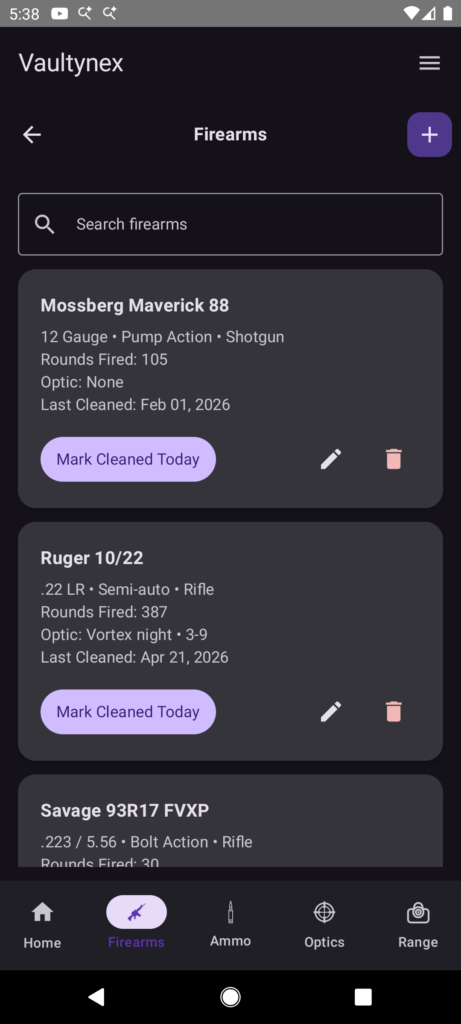
Vaultynex helps shooters do exactly that by keeping firearm records, range sessions, rounds fired, ammo usage, cleaning dates, and notes in one organized app.
Why Rounds Fired Matter for Firearm Cleaning
Rounds fired matter because every shot adds carbon, fouling, heat, residue, and wear.
The more you shoot, the more buildup can collect inside the firearm. That buildup may not cause a problem right away, but over time it can affect reliability, accuracy, and general performance.
Round count helps you understand:
• How much a firearm has been used
• When it may need cleaning
• Whether malfunctions started after heavy use
• Whether accuracy changed after a certain number of rounds
• Which firearms are being used most often
• Which firearms have gone too long without attention
This is especially useful if you own more than one firearm. You may remember shooting recently, but do you remember exactly which firearm had 200 rounds through it and which one only had 20?
That is where tracking matters.
General Firearm Cleaning Guidelines
There is no single perfect cleaning schedule for every firearm.
Cleaning frequency depends on the firearm, ammo, environment, round count, and how the firearm is used. Always follow your firearm manufacturer’s manual first.
That said, many shooters use rough round-count ranges to stay organized.
General examples:
• Light range use: inspect and clean as needed after each session
• Regular range use: clean after a few hundred rounds or when buildup is noticeable
• Rimfire firearms: may need more frequent attention because .22 LR can be dirty
• Defensive firearms: should be inspected and kept clean more consistently
• Hunting firearms: should be cleaned and checked before and after hunting trips
• Precision rifles: may need a more careful routine based on accuracy and barrel behavior
The point is not to obsessively scrub everything after every shot. The point is to know your firearm, track usage, and avoid running blind.
Clean Based on Firearm Type
Different firearm types may need different cleaning habits.
A semi-automatic handgun used for regular practice may build up residue differently than a bolt-action rifle. A shotgun may have different cleaning needs than a rimfire rifle. A firearm used heavily in one range session may need attention sooner than one that only fired a few rounds.
Common examples:
• Handguns may need regular cleaning after repeated range use
• Semi-automatic rifles may need attention around the action and chamber area
• Bolt-action rifles may need bore and chamber care based on accuracy needs
• Shotguns may collect residue depending on shells used
• Rimfire firearms often run dirtier and may need more frequent checks
• Firearms used for defensive purposes should be kept clean and reliable
This is why one universal cleaning rule is not enough.
A better system is to track each firearm individually.
Vaultynex lets you record round counts and cleaning dates per firearm, so each firearm has its own history.
Ammo Type Can Affect Cleaning Frequency
Ammo choice can affect how dirty your firearm gets.
Some ammo burns cleaner. Some leaves more residue. Some rimfire ammunition can be especially dirty. Some surplus, bulk, or lower-cost ammo may leave more fouling than premium ammo.
If you only track the firearm but not the ammo, you are missing part of the story.
Ammo can affect:
• Carbon buildup
• Fouling
• Reliability
• Accuracy
• Malfunctions
• Cleaning frequency
• Long-term performance notes
For example, if one firearm starts malfunctioning after using a certain ammo brand, that is worth recording. If another ammo type runs clean and accurate, that is also worth knowing.
Vaultynex helps connect ammo usage with range sessions, so you can look back and see what ammo was fired through each firearm.
Watch for Accuracy Changes
Cleaning is not only about reliability. It can also affect accuracy.
If your groups start opening up, your point of impact shifts, or the firearm feels inconsistent, cleaning history may be part of the picture.
This does not mean every accuracy issue is caused by a dirty firearm. Shooter fatigue, ammo changes, wind, optics, position, and distance can all matter too.
But if you track your range sessions properly, you can start comparing details.
You can review:
• Group size
• Rounds fired
• Ammo used
• Firearm used
• Optic used
• Distance
• Cleaning date
• Session notes
This helps you spot patterns.
If a firearm performs well after cleaning but starts grouping poorly after several hundred rounds, that is useful information. Without a range session log, you may never notice the pattern.
Track Malfunctions and Reliability Issues
Malfunctions are one of the clearest signs that something may need attention.
A single malfunction does not always mean the firearm is dirty. It could be ammo, magazine-related, grip-related, or caused by another issue. But repeated problems should be recorded.
You should track:
• Failure to feed
• Failure to eject
• Failure to fire
• Light primer strikes
• Magazine issues
• Extraction problems
• Accuracy changes
• Optic or zeroing issues
• Cleaning notes after the session
This helps you understand whether problems are random or repeated.
If a firearm runs perfectly for hundreds of rounds, then starts having issues after a certain round count, that matters. If the same issue happens only with one ammo type, that also matters.
Vaultynex helps you save those notes with your range sessions instead of trying to remember them later.
Why Cleaning Dates Should Be Tracked
Tracking rounds fired is useful, but tracking cleaning dates makes it much better.
If you only know total lifetime rounds fired, you still may not know how many rounds were fired since the last cleaning.
A better cleaning record includes:
• Total rounds fired by firearm
• Date last cleaned
• Rounds fired since last cleaning
• Notes about condition
• Malfunctions before cleaning
• Accuracy changes before cleaning
• Maintenance notes
This gives you a clearer picture of when each firearm needs attention.
For example, two firearms may both have 1,000 total rounds fired. But one may have been cleaned yesterday, while the other may not have been cleaned for months. Total round count alone does not tell the full story.
Vaultynex helps keep cleaning dates connected to firearm records so you can stay organized.
Do Not Rely on Memory
Memory is a terrible firearm maintenance system.
You may think you remember when you last cleaned a firearm, but if you own multiple firearms and shoot regularly, the details blur together fast.
You might forget:
• Which firearm you used last
• How many rounds were fired
• Which ammo was used
• Whether it had a malfunction
• When it was last cleaned
• Whether accuracy changed
• Whether it needs inspection before the next range trip
This is how firearms get neglected.
A written record or app-based system fixes that.
Vaultynex gives shooters a simple way to track firearm use, round counts, range sessions, and cleaning dates without relying on memory.
Firearm Cleaning and Maintenance Tracking in Vaultynex
Vaultynex is built to help shooters keep firearm records organized.
Instead of guessing when a firearm was last cleaned, you can track usage and maintenance details with the rest of your shooting history.
Vaultynex can help you track:
• Firearm records
• Total rounds fired
• Range sessions
• Ammo used
• Optics used
• Cleaning dates
• Session notes
• Malfunctions
• Group sizes
• Target photos
• Setup photos
• Performance insights
• Printable reports
• Backup and restore
This turns firearm cleaning from a guessing game into a record-based habit.
Download Vaultynex on Google Play and start turning your range sessions into useful data.
If you want a cleaner way to track your firearm inventory, ammo inventory, optics, and range sessions, Vaultynex gives you one place to keep it all organized.