Knowing what to record after every range trip is what turns a normal day at the range into useful shooting history.
Most shooters remember the obvious parts. They remember which firearm felt good, which group looked decent, or whether they had a frustrating session. But those memories fade fast. A few weeks later, the details start blending together.
Was that tight group shot with the same ammo you used last time? Was the optic already adjusted before the session? How many rounds did you fire? Did that malfunction happen with one magazine, one firearm, or one specific ammo brand? When was the firearm last cleaned?
If you are not recording those details, you are guessing.
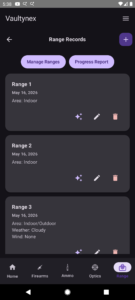
A good range trip record helps you understand your firearms, ammo, optics, accuracy, round counts, target photos, and shooting progress over time. Vaultynex gives shooters one place to keep those details connected instead of scattering them across paper notes, phone photos, spreadsheets, and memory.
Why Range Trip Records Matter
A range trip is more than just a few shots on paper.
Every range session gives you information about your gear, your habits, and your shooting performance. If you save the right details, you can use that information later. If you do not, the session disappears into memory.
Good range trip records help you answer questions like:
- Which firearm did I use?
- What ammo performed best?
- How many rounds did I fire?
- What optic was mounted?
- What distance was I shooting?
- What group size did I record?
- Did I take target photos?
- Were there malfunctions?
- Does the firearm need cleaning?
- Am I actually improving over time?
That is the difference between a casual memory and a useful shooting log.
If you want a deeper look at why this matters, read why you should keep a range session log.
Record the Date and Range Location
The first thing to record after every range trip is the date and location.
This sounds basic, but it matters. Once you start building a shooting history, dates help you compare sessions over time. You can look back and see when you practiced, how often you trained, and whether your shooting improved over weeks or months.
Range location can also matter because different ranges may have different distances, lighting, target setups, benches, weather exposure, and shooting conditions.
You should record:
- Date of the range trip
- Range name or location
- Indoor or outdoor range
- Distance options used
- Any special conditions that affected the session
This gives your range trip record a clear starting point.
Record Which Firearms You Used
After every range trip, record each firearm you used.
This is one of the most important details because your results only matter if they are tied to the correct firearm. A target photo, group size, malfunction, or ammo note is not very useful if you cannot remember which firearm it came from.
For each firearm, record details like:
- Manufacturer
- Model
- Caliber
- Action type
- Serial number if you track it
- Rounds fired during the session
- Notes about performance
This helps you build a usage history for each firearm instead of keeping a loose list of what you own.
Vaultynex connects range trips to your firearm records through its firearm inventory app features, so each range session becomes part of the firearm’s history.
Record Ammo Used During the Session
Ammo is one of the biggest details to record after every range trip.
Different ammo can produce different results, even in the same firearm. One brand may group well. Another may cause malfunctions. One load may be fine for casual practice but not ideal for accuracy testing.
After each range trip, record:
- Caliber
- Brand
- Ammo type
- Bullet weight
- Casing type
- Quantity fired
- Cost per round if known
- Reliability notes
- Accuracy notes
This helps you understand which ammo is worth buying again and which ammo should stay off your list.
Vaultynex helps with ammo tracking, so your ammo inventory and range trip usage stay connected. You can also read how to track ammo inventory without a spreadsheet and how to calculate ammo cost per round.
Record Rounds Fired
Rounds fired should be recorded after every range trip.
This is not just about knowing how much you shot. Round count affects ammo inventory, firearm usage, maintenance planning, training volume, and long-term records.
You should record:
- Total rounds fired during the trip
- Rounds fired by firearm
- Rounds fired by ammo type
- Rounds fired during accuracy testing
- Rounds fired during practice drills
Round count helps you understand how heavily each firearm is being used. It also helps you spot patterns if reliability or accuracy changes over time.
For example, if a firearm starts having issues after several hundred rounds without cleaning, your range trip records can help explain what happened.
Vaultynex connects range session records with round counts and maintenance tracking. You can learn more on the firearm maintenance tracker page.
Record Optics and Gear Setup
If you use scopes, red dots, mounts, rests, bags, bipods, or other gear, record the setup used during the range trip.
Gear matters because your results are not only about the firearm. Your optic, zero, magnification, shooting rest, and setup can all affect performance.
After each range trip, record:
- Optic used
- Firearm the optic was mounted on
- Magnification setting if relevant
- Zeroing notes
- Mount or ring changes
- Rest, bag, bipod, or bench setup
- Any gear issues
This is especially important if you move optics between firearms or test different setups.
Vaultynex helps keep optics connected to your firearm and range session records through optics tracking. That way, your shooting results stay tied to the setup you actually used.
Record Shooting Distance and Position
Shooting distance gives your range results context.
A tight group at 25 yards is not the same as a tight group at 100 yards. If you record group size without distance, the data is incomplete.
You should record:
- Shooting distance
- Shooting position
- Bench, standing, seated, prone, or supported position
- Type of rest or support used
- Any changes between groups
This helps you understand where your shooting is strong and where it needs work.
If your accuracy is solid from the bench but weak from standing, that tells you something. If your groups are good at 50 yards but open up at 100 yards, that gives you a clear area to improve.
Record Group Size and Accuracy Results
Group size is one of the clearest ways to track shooting accuracy over time.
After each range trip, record your best group, average group, distance, firearm, ammo, optic, and position. The more context you save, the more useful the number becomes.
You should record:
- Group size
- Number of shots in the group
- Distance
- Firearm used
- Ammo used
- Optic used
- Target photo if available
- Notes about flyers or point of impact
Do not only record your best group. That is how shooters lie to themselves. Your best group is useful, but your average results are usually more honest.
Vaultynex helps shooters connect group size records to range sessions, target photos, firearms, ammo, and optics. You can learn more on the group size tracking app page and in the guide on how to track group size and shooting accuracy over time.
Save Target Photos
Target photos are one of the most useful things to record after a range trip.
A group size number is helpful, but a photo shows what actually happened. It shows shot placement, point of impact, flyers, horizontal spread, vertical spread, and whether the group was centered.
Target photos help you review:
- Shot placement
- Group shape
- Point of impact
- Flyers
- Zeroing changes
- Ammo performance
- Firearm performance
- Progress over time
The problem is that target photos lose value when they are buried in your phone gallery with no notes attached.
A useful target photo should be connected to the range trip, firearm, ammo, optic, distance, group size, and notes.
Vaultynex helps with target photo tracking, so your target pictures stay attached to the session where they belong. You can also read why target photos are useful in a shooting log.
Record Malfunctions and Problems
Do not ignore malfunctions after a range trip.
A single issue may not mean much, but repeated issues can reveal a pattern. If you do not record them, you may miss the connection between ammo, magazines, firearm condition, round count, or cleaning history.
Record problems like:
- Failure to feed
- Failure to eject
- Failure to fire
- Light primer strikes
- Magazine issues
- Optic problems
- Accuracy changes
- Point of impact shifts
- Cleaning or maintenance concerns
These notes are not just for troubleshooting. They also help you decide whether a firearm, ammo type, magazine, or setup needs more attention before the next range trip.
Record Cleaning and Maintenance Notes
Range trip records should connect to firearm maintenance.
If you fired a lot of rounds, used dirty ammo, shot in poor conditions, or noticed malfunctions, the firearm may need cleaning or inspection.
After every range trip, record:
- Whether the firearm was cleaned
- Date last cleaned
- Rounds fired since last cleaning
- Any malfunctions before cleaning
- Any parts or wear concerns
- Maintenance notes
This helps you avoid relying on memory.
Cleaning frequency depends on the firearm, ammo, use, and conditions, but tracking round counts and cleaning dates gives you a better system than guessing.
You can read more about how often you should clean your firearm based on rounds fired.
Record Weather and Range Conditions
Weather and range conditions can affect shooting results, especially outdoors.
Wind, lighting, temperature, rain, snow, heat, glare, and target visibility can all affect how a session goes.
Useful condition notes include:
- Wind direction
- Wind strength
- Temperature
- Lighting
- Rain, snow, or humidity
- Target visibility
- Bench or range conditions
You do not need to overdo this for every casual session, but if you are comparing accuracy, sight-in results, or ammo performance, conditions matter.
Record What You Want to Improve Next Time
One of the most overlooked things to record after every range trip is what you want to improve next time.
This does not need to be complicated. A simple note can help you turn one range trip into a better plan for the next one.
Examples include:
- Test a different ammo brand
- Confirm zero at 100 yards
- Work on trigger control
- Practice from standing position
- Bring more .22 LR next time
- Clean firearm before next session
- Retest group size after optic adjustment
This turns your shooting log into an improvement tool instead of a basic diary.
Range Trip Recording Checklist
After every range trip, try to record the details that will actually help you later.
- Date and range location
- Firearms used
- Ammo used
- Rounds fired
- Optics and gear setup
- Shooting distance
- Shooting position
- Group size
- Target photos
- Malfunctions or problems
- Cleaning and maintenance notes
- Weather and range conditions
- What to improve next time
You do not need to write a novel after every session. The goal is to save the details that make your range history useful.
How Vaultynex Helps You Record Range Trips
Vaultynex is built to help shooters record range trips without relying on scattered notes, screenshots, spreadsheets, or memory.
With Vaultynex, you can keep your shooting records connected:
- Firearm inventory
- Ammo inventory
- Optics tracking
- Range session logs
- Rounds fired
- Group size tracking
- Target photos
- Maintenance notes
- Malfunction notes
- Cost per round
- Performance history
- Backup and restore
The point is not to collect random data. The point is to keep the right information connected so you can actually use it later.
If you want a broader system for organizing your shooting records, read the best way to organize firearms, ammo, and optics.
Related Vaultynex Features
These feature pages connect directly to better range trip records:
- Range Session Tracking App
- Firearm Inventory App
- Ammo Tracking
- Group Size Tracking App
- Target Photo Tracking App
- Optics Tracking App
- Firearm Maintenance Tracker App
Related Reading
These related guides can help you build better shooting records:
- Why You Should Keep a Range Session Log
- How to Track Ammo Inventory Without a Spreadsheet
- How to Track Group Size and Shooting Accuracy Over Time
- Why Target Photos Are Useful in a Shooting Log
- How Often Should You Clean Your Firearm Based on Rounds Fired?
Range Trip Recording FAQ
What should I record after a range trip?
After a range trip, record the date, range location, firearms used, ammo used, rounds fired, optics, distance, shooting position, group size, target photos, malfunctions, maintenance notes, and anything you want to improve next time.
Why should I record ammo used during a range trip?
You should record ammo used during a range trip because different ammo can affect accuracy, reliability, group size, and firearm performance. Tracking ammo also helps keep your inventory accurate after shooting.
Should I take target photos after every range trip?
Target photos are useful because they show shot placement, group shape, point of impact, flyers, and progress over time. They are much more useful when saved with firearm, ammo, optic, distance, and session notes.
How do range trip records help with firearm maintenance?
Range trip records help with maintenance by tracking rounds fired, cleaning dates, malfunctions, and firearm usage. This makes it easier to know when a firearm may need cleaning or inspection.
Can Vaultynex replace paper range notes?
Vaultynex is designed to give shooters a cleaner way to record range trips, firearms, ammo, optics, target photos, group sizes, round counts, and maintenance notes without relying on paper notes or spreadsheets.
Download Vaultynex
Start using Vaultynex to record every range trip and keep your firearms, ammo, optics, target photos, group sizes, round counts, and maintenance notes connected in one app.
Download Vaultynex on Google Play
Final Thoughts
If you only remember one thing, make it this: a range trip record is only useful if it saves the details you will forget later.
Do not rely on memory. Record the firearm, ammo, optic, distance, group size, target photos, round count, maintenance notes, and anything that affected the session.
Vaultynex helps you keep that information organized so every range trip becomes part of a useful shooting history.